
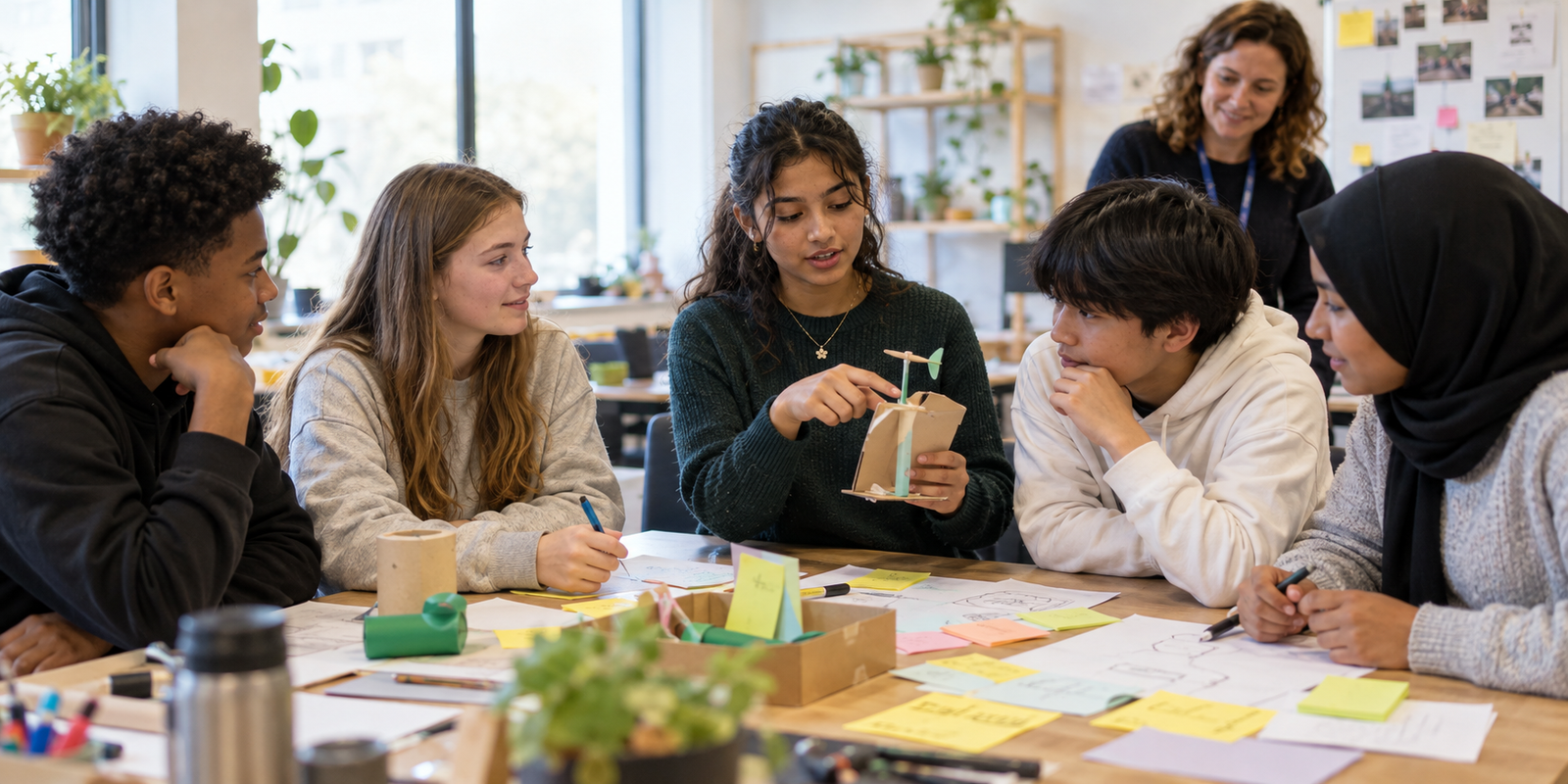
“I am not creative” often means “I do not want to show something that might be judged.” A young person may have ideas but keep them private because a rough sketch feels like a public test of ability.
Adults can make creative work easier to begin by reducing the stakes and clarifying what the first attempt is for. Confidence does not have to arrive before action; a small, supported action can provide something concrete to build on.
Make the first version deliberately rough
Offer scrap paper and a short design brief. Ask for three possible approaches rather than one perfect answer. A sketch can use arrows and labels; drawing skill should not become the hidden entry requirement.
Show an imperfect example of your own and explain what question it is meant to answer. Avoid presenting a highly polished adult model that learners feel they must match.
Give choice over sharing
Some learners are ready to present to a group. Others may begin by showing a trusted partner or leaving a written explanation beside the work. Agree the format before the activity so nobody faces an unexpected public performance.
Do not post a child’s work, name or image online as a reward without the appropriate permissions. Private progress is still progress.
Make feedback specific and usable
“That is brilliant” may be encouraging, but it gives little direction. “The large label helped me find the opening” names a useful design decision. “I could not tell where to hold it” identifies something the maker can investigate.
Ask the learner what they want feedback on. A response about colour is less helpful if they are testing whether a handle is strong enough.
Leave the revision in their hands
An adult can suggest a question or demonstrate a technique, then hand the decision back. If the adult changes the design while explaining, the learner may conclude that their version was never acceptable.
Invite a reasoned choice: “Which part will you change first, and what do you expect it to improve?” They can also decide to keep a feature when the evidence supports it.
Recognise the action behind the confidence
Notice when the young person starts sooner, asks a clearer question or shares an unfinished idea. Compare with their own earlier attempt, not the most confident participant in the room.
Creative confidence grows through experiences that feel manageable and meaningful. It is not a promise that uncertainty disappears. Our guide to handling criticism offers a related approach when feedback feels difficult.