
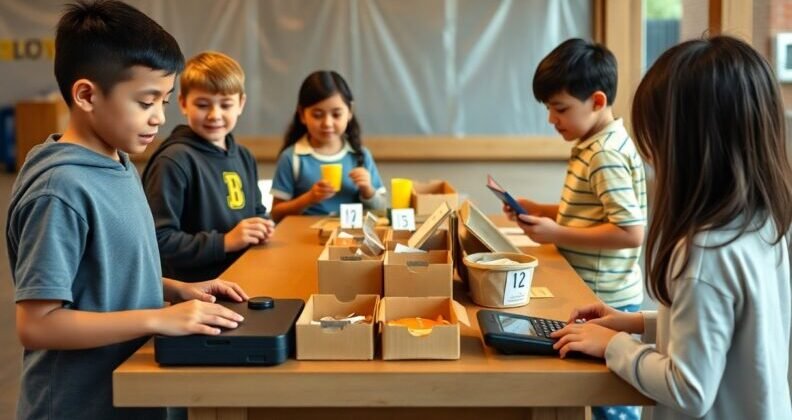
A primary class designs a sign for its reading corner. Learners decide who needs it, measure the space, compare wording and test whether another child can understand it. No money changes hands, but the activity contains useful enterprise learning.
In the primary years, enterprise education can provide a purpose for applying knowledge. It should be adapted to the children and avoid treating commercial success as the measure of their ability.
Connect skills around a shared task
Reading helps learners understand a brief. Writing helps them explain an offer or instruction. Mathematics helps them compare quantities and work within a material limit. Discussion helps them consider another person’s needs.
The task makes those connections visible. It complements subject learning by asking what the knowledge can help someone do in a particular situation.
Create decisions children can own
Give a clear purpose and a few safe boundaries, then leave a choice open. Children might compare two ways to organise a pretend shop or decide which information belongs on a label.
An adult-designed product assembled by children can be enjoyable, but it offers a different kind of learning. Make sure an enterprise task includes some thinking that genuinely belongs to the learner.
Make participation broad
Include practical, visual, written and spoken contributions. Offer accessible materials and alternative ways to explain a decision. Public presenting and fast mental arithmetic should not become the only recognised forms of success.
Where families have different resources, provide the materials centrally or use a no-spend task. Avoid homework that assumes parents can buy stock, organise sales or supply professional skills.
Keep money learning proportionate
Pretend prices and counters can introduce a budget or the difference between sales and costs. A real fundraiser may involve extra permissions and responsibilities, so adults should decide whether trading adds enough educational value to justify it.
Children should not feel responsible for raising essential funds or competing over family spending power. The learning can be complete without selling anything.
Look for a clear explanation
At the end, ask what the child chose, what happened and what they might change. A drawing of two versions or a demonstrated improvement can be useful evidence.
Do not assume a lasting confidence gain from one enjoyable event. Look for the skill again in another setting and offer further practice. Enterprise education matters when it helps children use knowledge, consider other people and make thoughtful decisions. Our parent and teacher guide explores how to keep that learning connected across settings.